Wednesday, August 18, 2010

Today the minimum temperature of the 'puparium' was 26C, while the maximum was 31C. A bit warm, but still well within the happy zone.
We had 3 adults emerge- one was a beautiful, healthy female and the other two looked like males. The maybe-males had very very recently emerged- their wings had not even fully formed yet.
I counted an amazing, record-setting 278 crawl-off today. It seems like we really can hope for a saturation of BSF, and a much greater likelihood of a return!

Tuesday, August 17, 2010

The pupa bucket only had 1 adult fly, but it looks healthy, with fully-formed and functional wings.
15-crawl off in the last 24-hours.
We moved the pod to an open field, further away from distractions (esp. the large green dumpster and compost piles).
We again saw a female adult fly checking out the pod, so it looks like our idea to add more compost to the pod is in fact attracting females.

Monday, August 16, 2010

What is a Distraction?

A distraction is anything that would make a female (adult) decide to lay her eggs anywhere except for the pod.
Because maggots live on food scraps, females will choose a place with the largest amount of food to increase the chance that her offspring will survive.
Therefore, any area with a large amount of food scraps such as a compost pile of a large dumpster would distract the female from laying her eggs in the pod.
When eggs are laid outside fo the pod, they are not a part of our BSF colony, and the maggots are not in the pod to create the synonome. Nor can we increase the size of our colony or conduct experiments to determine the number of maggots needed to reduce a pound of food scraps in one hour (for example).
Because of this, when we first did a survey of UBC Farm, we looked for distractions. Although there was a large green dumpster as well as a compost bin nearby (about 50 meters away), we did not consider them to be worrisome since BSF are weak fliers and we thought they would prefer to stay close to the pod and would be attracted by the synonome.
However, because we have seen 2 gravid (pregnant) females but no eggs in the pod (yet!), we now consider the dumpster and compost pile to be worrisome distractions especially since we now only have about half of our maggots left, creating only half of the synonome.
Therefore we have decided to move the pod further from the dumpster and compost pile and hopefully will see the desired result- eggs.

23

When we took the lid off of the black pupa bucket ('puparium') and TWENTY-THREE adults flew out! Very exciting. This is by far the largest number of adults that we have had alive at one time; with this great, hot and sunny weather we are in a greatest position yet to see some eggs.
One female adult was checking out the pod for about a half hour. Very good sign.
On top of this, we have a record amount of crawl-off: 113! A very happy day in the land of BSF, overall.

Saturday, August 14, 2010

Looks like our contraption is working- the black bucket, which Rylo and I refer to as the "puparium" had a minumum temperature of 24.4C. That's definitely in the 'happy' range.
We only had two adults emerge today, and both had issues with wing formation. For some reason, about 10% of our adults have wing issues, a fact which we attribute to a lower humidity. Hopefully the new environment we have created is more regulated and we will not see too many more of these gimpy adults.
We will expect a large emergence soon, as today is day 13 after 84 larvae pupated (on 2 August).

Thursday, August 12, 2010

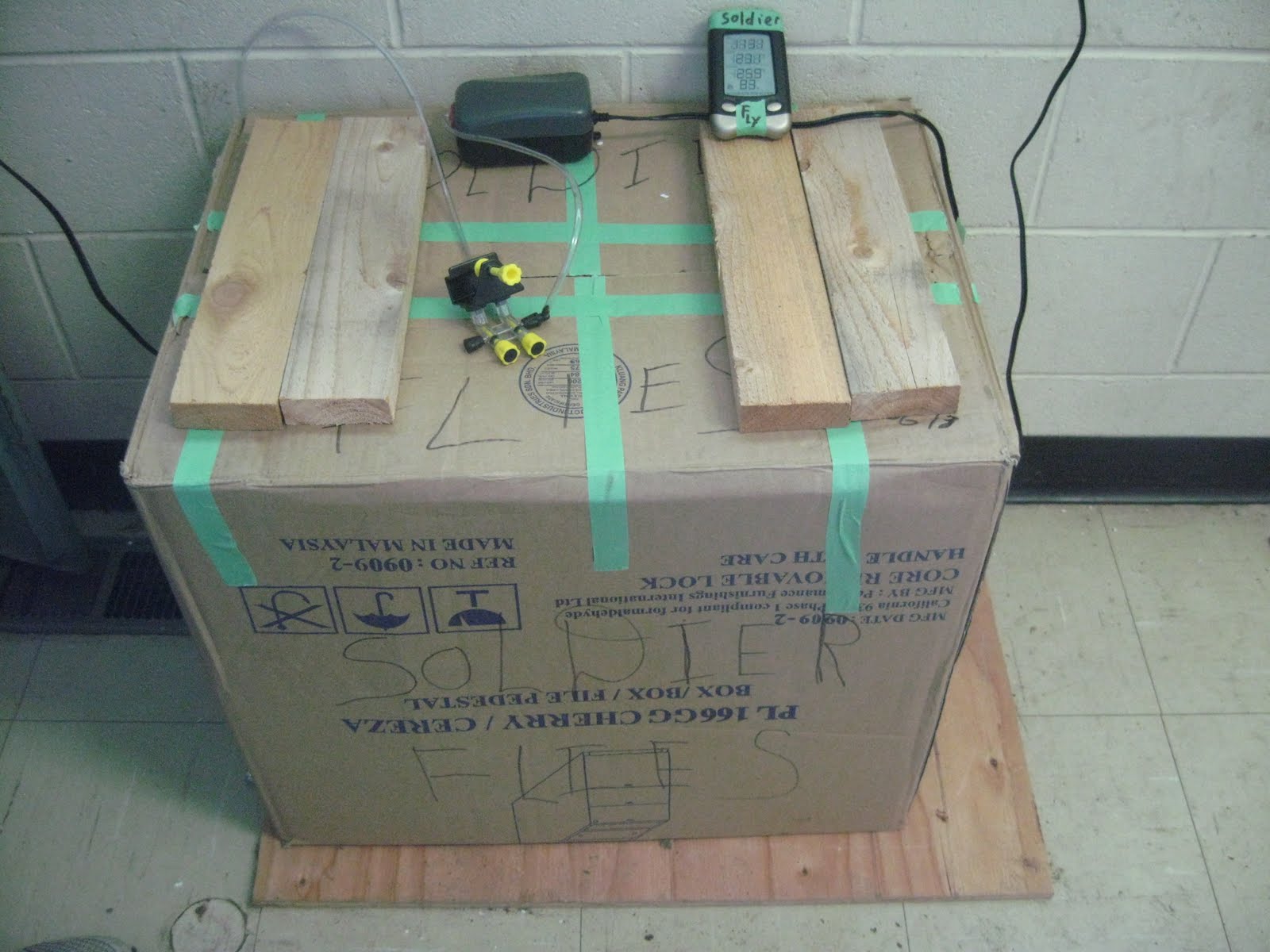
"Puparium" Assembly


Today we assembled a bucket to store our pupa to maintain a constant temperature of 24/25C and humidity of ~60%. We hope that this will reduce the amount it takes for the pupa to mature and for the adult to emerge.
Our contraption consists of a large cardboard box with our black bucket (that we place our pupa in), a heater, a thermometer and an air lift that we took from the chamber. We placed it inside of the classroom (in the Admin building) at UBC Farm.
We now keep a spray bottle with apple cider vinegar next to the pod. We think it's working because we've seen female adults check out the pod every day. By checking out the pod, I mean the female fly sits on the outside of the pod for an extended period of time, usually more than ten or fifteen minutes.
We also added more compost to the pod, hoping that it will attract more females and we will get some EGGS!

Wednesday, August 11, 2010

Today I checked the pod at 12 noon. The maximum temperature in the last 24 hours was 20.5C and the minimum was 15.1C; the current temperature is 18.4C.
The black pupa bucket has a current temperature of 21.6C and 80% humidity. We'd like to get it up to a constant temperature of 25C and lower the humidity to close to 60%. I'll have to think up a way to get our numbers up/down.
We had 87 crawl-off today, with about 80% crawling around, indicating they have not quite reached pupation and are still just mature larvae. I noticed that when we placed the mature larvae in the sunlight, they became significantly more active.
Right now we are looking for a place to overwinter our larvae (of course, IF we get eggs, and right now it seems that this is a big if). Likely, we'll settle on a large fridge or freezer.